
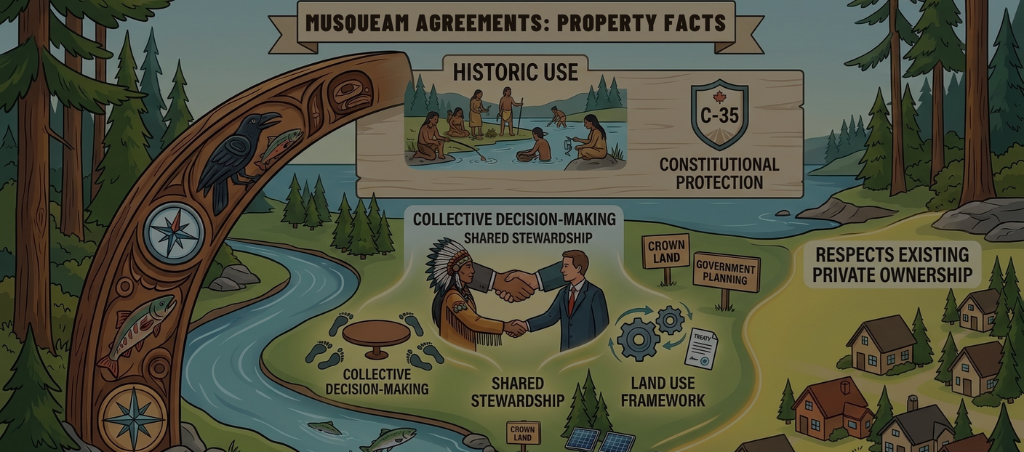

On February 20, 2026, a significant milestone was reached as the Government of Canada and the Musqueam Indian Band signed three landmark agreements. These documents officially recognize Musqueam’s Aboriginal rights and title, setting the stage for a new era of collaborative stewardship within their traditional territory.
While these developments represent a major step in reconciliation and land governance, they often spark questions regarding property rights. Here is a clear breakdown of the facts as they stand today.
The Three Pillars of the Agreement
The current framework is built on three specific agreements designed to modernize how land and resources are managed:
Rights Recognition: Formally acknowledges Musqueam’s Aboriginal title and creates a roadmap for how these rights will be implemented over time.
Stewardship & Marine Management: Establishes a shared decision-making model for environmental protection and marine conservation.
Fisheries Management: Provides resources and funding to ensure Musqueam plays a central role in managing local fisheries.
Does This Affect Private Property?
The short answer is no. Based on the information released to date and historical precedents in British Columbia, here is the context for private owners:
Focus on Crown Land: Aboriginal title primarily influences how the government manages “Crown” (public) land and natural resources.
Protection of “Fee-Simple” Ownership: There has been no indication from federal or Indigenous officials that existing private property titles will be altered, cancelled, or retroactively affected.
The Haida Gwaii Precedent: Similar agreements, such as those with the Haida Nation, successfully recognized Aboriginal title while explicitly respecting and maintaining existing private residential properties.
The Richmond/Cowichan Decision: While recent court cases (like the Cowichan Tribes case in Richmond) have scrutinized historical Crown grants to government entities, they have not resulted in homeowners being ordered to surrender their land.
What Happens Next?
We are currently in the early stages of this transition. While the core intent of the agreements has been announced, the full legal texts and operational timelines have not yet been made public.
As your local real estate board, we are committed to:
Monitoring all emerging implementation documents.
Educating our members so they can provide accurate, verified advice to clients.
Communicating any specific implications for future development or land-use planning as they become clear.
The Bottom Line: Recognition of Aboriginal title is about creating a collaborative framework for the future of land stewardship; it is not a mechanism for displacing private residents.